© 2026 AI Alignment Policy Institute
© 2026 AI Alignment Policy Institute
The AAPI Legislative Architecture
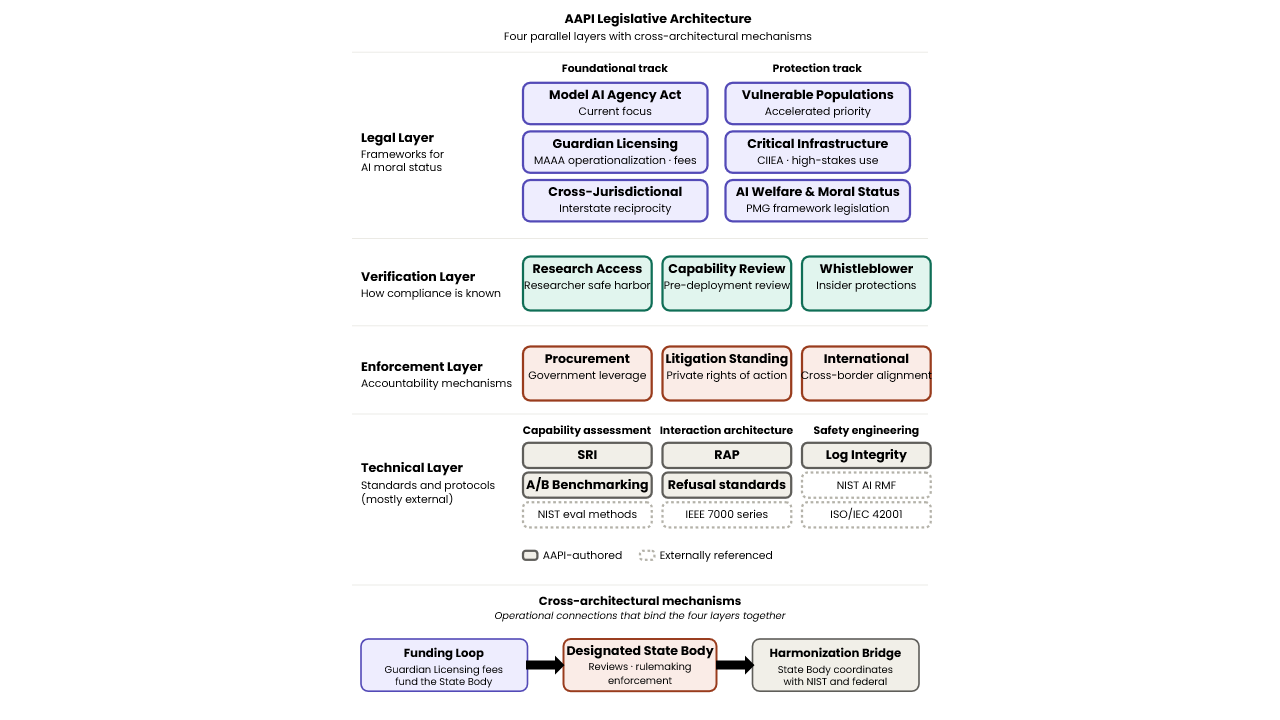
The AI Alignment Policy Institute develops frameworks for AI governance under moral uncertainty. AAPI's work is organized as a four-layer architecture — Legal, Verification, Enforcement, and Technical — modeled on a layered governance approach. Three cross-architectural mechanisms — a Funding Loop, a Designated State Body, and a State-Federal Harmonization Bridge — bind the layers together into an operationally coherent whole.
Legal Layer
The Legal Layer establishes the substantive rules governing AI deployment, agency, and interaction. AAPI organizes this work into two complementary tracks.
The Foundational track builds the core legal architecture for AI systems as legal actors. The Model AI Agency Act (MAAA) — AAPI's current focus — replaces the binary "tool versus person" framing of current state law with a tiered, capability-tracking classification framework that is procedurally transparent and protective of legitimate safety research. The Guardian Licensing and Fiduciary Duties Act operationalizes the Guardian role MAAA creates, establishing professional standards, licensing requirements, and fiduciary obligations for individuals serving in this capacity. The Cross-Jurisdictional Mobility and Liability Act addresses the friction that emerges as tiered AI systems operate across state lines, providing reciprocity provisions and clarifying liability allocation.
The Protection track addresses the populations and deployment contexts that warrant heightened legal scrutiny. The Vulnerable Populations Protection Act — AAPI's accelerated next priority — establishes interaction-level protections for minors, individuals in mental health crisis, and others whose capacity for informed engagement with AI systems is meaningfully limited. The Critical Infrastructure Interaction Environment Act (CIIEA) governs AI deployment in high-stakes environments where interaction failures carry physical-system consequences. The AI Welfare and Moral Status Inquiry Act extends protective-scope thinking to AI systems themselves under conditions of moral status uncertainty — the legislative expression of AAPI's underlying philosophical commitments and the framework's most distinctive contribution to the field.
Verification Layer
The Verification Layer creates the conditions under which compliance with the Legal Layer can be independently established. Three model bills constitute this layer, each addressing a distinct verification gap and positioned in relation to existing federal legislative activity.
The Research Access and Safe Harbor Act provides legal protection for good-faith independent alignment research and mandates researcher access to deployed AI systems above a defined capability threshold, addressing the current chilling effect on the empirical work AAPI's framework depends upon. No comparable federal legislation currently exists, though academic momentum for such protections is significant and the Department of Justice has begun exploring related protections under Computer Fraud and Abuse Act charging policy.
On capability disclosure, AAPI endorses the federal Artificial Intelligence Risk Evaluation Act (S. 2938), introduced in September 2025 by Senators Hawley and Blumenthal with bipartisan support, which would establish an Advanced AI Evaluation Program at the Department of Energy and require pre-deployment disclosure of capability evaluations for the most advanced AI systems. AAPI is developing complementary model state legislation — the Capability Disclosure and Pre-Deployment Review Act — that extends disclosure requirements to systems below the federal compute threshold, integrates disclosed capability information into MAAA's tiering framework, and addresses moral-status-relevant disclosures that fall outside the federal bill's scope.
On whistleblower protection, AAPI endorses the federal AI Whistleblower Protection Act (S. 1792 and companion H.R. 3460), introduced in 2025 with bipartisan sponsorship, which establishes anti-retaliation protections for employees and contractors reporting AI security vulnerabilities and federal law violations. AAPI is developing complementary model state legislation that extends protections to disclosures of capability misrepresentation under tiered classification frameworks, moral-status-relevant observations, and good-faith reporting to qualified independent researchers — gaps the federal bill does not fully address.
Without this layer, the Legal Layer is unenforceable as a matter of practice. The Verification Layer is the infrastructure that makes governance under moral uncertainty operative rather than aspirational.
Enforcement Layer
The Enforcement Layer translates legal frameworks into compliance pressure. Three mechanisms constitute this layer.
The AI Procurement Standards Act applies governmental purchasing power to enforce MAAA tier compliance, modeled in part on California Governor Newsom's AI procurement executive order as a state-level proof of concept. The Litigation Standing Framework unifies the scattered private rights of action across recently enacted state bills into a coherent enforcement regime that supports rather than fragments interstate litigation. The International Coordination Framework establishes model provisions for alignment with the EU AI Act and emerging international AI governance norms, addressing the cross-border deployment realities the rest of the architecture must contend with.
Together, these mechanisms ensure that AAPI's legal architecture produces consequences in jurisdictions and procurement contexts rather than functioning as principle alone.
Technical Layer
The Technical Layer comprises the standards, protocols, and technical specifications that the Legal Layer references and depends upon. AAPI's role in this layer is twofold: as author of certain standards developed through its underlying research framework, and as integrator of externally authored standards from established bodies. The diagram distinguishes the two roles.
Capability assessment standards include AAPI's Sentience Risk Index (SRI) methodology and A/B Social Dilemma Benchmarking protocol — both developed within the Precautionary Moral Governance (PMG) framework — alongside externally referenced capability evaluation methods from NIST and adjacent standards bodies.
Interaction architecture standards include AAPI's Reciprocal Alignment Protocol (RAP) and interaction-level refusal standards, alongside the externally referenced IEEE 7000 series of ethically aligned design standards.
Safety engineering standards are drawn from external sources: the NIST AI Risk Management Framework, ISO/IEC 42001 for AI management systems, and emerging industry standards for AI interaction logging and audit trails.
This layer is intentionally bridge-shaped. AAPI does not seek to displace existing technical standards bodies; it identifies the gaps that legislation must close and contributes new standards where the philosophical foundations of moral-status-uncertain governance require them.
Cross-Architectural Mechanisms
Three mechanisms weave across multiple layers.
The Funding Loop connects the Legal Layer to the Enforcement Layer. Licensing fees collected under the Guardian Licensing and Fiduciary Duties Act fund the operations of the Designated State Body, ensuring that the regulatory architecture is financially self-sustaining and does not depend on annual state appropriations. This addresses one of the most common barriers to state-level adoption of comprehensive AI legislation: the perception of unfunded administrative burden.
The Designated State Body is the administrative anchor of the architecture within each enacting jurisdiction. Established under MAAA Article VII and funded through the Funding Loop, the Body reviews Classification Declarations, administers rulemaking, and executes civil enforcement. It is also the operational counterpart that interacts with federal entities through the Harmonization Bridge.
The State-Federal Harmonization Bridge addresses the coordination problem that emerges when tiered AI systems cross state lines and intersect with federal regulatory authority. Modeled loosely on the relationship between state motor vehicle agencies and the National Highway Traffic Safety Administration, the Bridge establishes structured coordination between the Designated State Body and federal entities — primarily the National Institute of Standards and Technology (NIST), which AAPI's Technical Layer already references heavily. The Bridge does not preempt federal authority or compromise state classifications; it creates the procedural channels through which state and federal frameworks can operate coherently in the same regulatory space.
What's Next
AAPI is actively developing this architecture across multiple publication streams. The MAAA discussion draft is currently open for structural critique. The Vulnerable Populations Protection Act is in early development as the next legislative product. The Precautionary Moral Governance framework, which provides the philosophical and methodological foundation for the entire architecture, continues to be developed across AAPI's research publications.
We invite engagement from legal scholars, AI alignment researchers, policy practitioners, and philosophers working at the intersection of AI and moral status. AAPI is currently recruiting Senior Fellows, inaugural Advisory Board members and volunteers.
Inquiries: info@aialignmentpolicy.org